
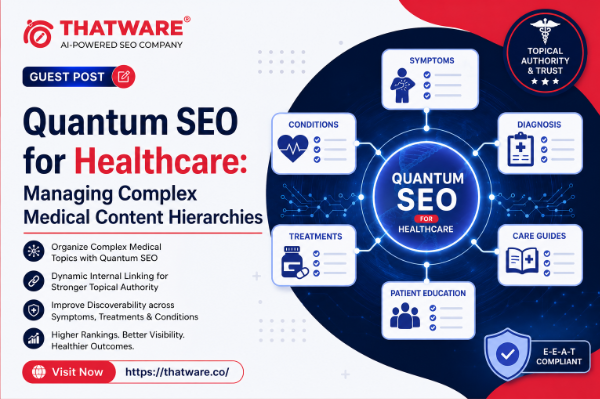
Healthcare SEO exists in a different universe from most other verticals. The stakes aren’t just business outcomes — they’re genuinely about patient wellbeing. A person searching for symptoms, treatments, or providers is often vulnerable, scared, or making decisions that will significantly affect their health. Google knows this and has built its quality evaluation systems to reflect it.
The YMYL (Your Money or Your Life) designation applies with full force to healthcare content. Quality standards are higher. Trust signals matter more. E-E-A-T (Experience, Expertise, Authoritativeness, Trustworthiness) requirements are enforced more strictly. And the complexity of medical content hierarchies — the intricate relationships between conditions, treatments, providers, facilities, specialties, and regulatory frameworks — creates structural SEO challenges that simple keyword targeting can’t address.
Quantum SEO for healthcare is designed for precisely this environment: complex, high-stakes, deeply regulated, and requiring a level of semantic sophistication that most SEO approaches simply don’t provide.
Why Healthcare SEO Is Structurally Different
Before getting to solutions, it helps to understand specifically what makes healthcare SEO harder than other verticals.
Medical content hierarchy depth — The ontology of medical knowledge is extraordinarily complex. A single condition has associated symptoms, subtypes, risk factors, diagnostic criteria, treatment approaches, drug interactions, specialist types, specialist organizations, clinical guidelines, patient populations, comorbidities, and research trajectories. Covering this hierarchy comprehensively — in a way that satisfies both patient intent and Google’s medical quality standards — requires systematic content architecture, not ad-hoc blog posting.
Regulatory content constraints — Healthcare content operates under significant regulatory constraints. Claims need to be defensible, information needs to be current, and treatments need to be characterized accurately. Content that’s even slightly misleading or outdated can damage both patient wellbeing and brand trust.
Dual audience complexity — Healthcare sites often need to serve both patient audiences (accessible, empathetic, practical information) and professional audiences (clinical, precise, evidence-based information). These require different content approaches and create different SEO dynamics.
Trust signal requirements — Google’s quality rater guidelines for healthcare content emphasize credentials, citations to authoritative medical sources, author expertise, and organizational trust signals. Sites that don’t explicitly surface these signals underperform in medical search, regardless of content quality.
The Medical Knowledge Graph: Your SEO Foundation
Quantum SEO for healthcare visibility begins with building a comprehensive medical knowledge graph for your site’s domain — a structured representation of all the medical entities (conditions, treatments, medications, procedures, specialists, facilities) that your content ecosystem covers and their relationships to each other.
This knowledge graph serves as the architectural blueprint for content planning, internal linking, structured data implementation, and entity authority building.
Entity mapping — Systematically identifying every medical entity relevant to your specialty or service area and mapping its relationships: which conditions are treated by which procedures, which specialties address which condition clusters, which treatments have which contraindications or interactions.
Content gap analysis against the knowledge graph — Comparing your existing content inventory against the knowledge graph to identify which entities and relationships are covered, which are partially covered, and which are absent. The gaps represent priority content opportunities.
Authority topology mapping — Analyzing which entities in your knowledge graph are most central (most connected to other entities) and ensuring these receive the most comprehensive content coverage and the highest internal link authority.
This entity-first approach ensures that your content architecture reflects the actual structure of medical knowledge rather than an arbitrary collection of keyword-targeted articles.
E-E-A-T at Scale: Systematic Trust Signal Architecture
Experience, Expertise, Authoritativeness, and Trustworthiness — Google’s quality evaluation framework for healthcare content — can’t be bolted onto a site as an afterthought. They need to be systematically built into the content architecture.
Author credentialing system — Every piece of medical content should have a clearly identified author with verifiable medical credentials. This requires a structured author profile system that surfaces credentials, specialization, institutional affiliations, and published work in a format that both readers and search engines can easily interpret.
Medical review workflows — Content needs to be reviewed and approved by credentialed medical professionals before publication, with review dates and reviewer credentials displayed. This isn’t just good practice — it’s a meaningful quality signal that affects how search engines evaluate content trustworthiness.
Citation infrastructure — Healthcare content should consistently cite authoritative sources: peer-reviewed research, clinical guidelines from major medical organizations, government health agencies. A systematic citation infrastructure — standardized citation formatting, regular link health checking, periodic source currency review — ensures citations remain accurate and functional at scale.
Institutional authority signals — Organizational trust signals matter: accreditations, certifications, provider credentials, academic affiliations, and regulatory compliance indicators. Structured data markup that makes these signals machine-readable significantly improves how search engines assess site-level trustworthiness.
Managing Content Currency at Scale
Medical knowledge evolves continuously. Clinical guidelines update. Drug safety profiles change. Treatment protocols improve. Healthcare content that was accurate when published can become outdated — and outdated medical content is both a patient safety issue and a serious SEO liability.
Quantum SEO for healthcare implements systematic content currency management:
Content freshness scoring — Each piece of content is tagged with the medical topics it covers and monitored against a freshness schedule that varies by topic type. Content about rapidly evolving conditions (infectious disease, oncology treatment protocols) has shorter review cycles than content about stable medical topics.
Automated staleness detection — Integration with medical knowledge sources (clinical guideline databases, FDA safety communications, major journal publication feeds) that flags content for review when relevant guidelines or evidence changes.
Structured update workflows — When content requires updating, a structured workflow ensures the update is reviewed by an appropriate medical professional, accurately reflects current evidence, and is documented with updated review dates and reviewer credits.
This systematic approach to content currency is both a trust signal for search engines and a patient safety responsibility — which aligns them in an unusual way that makes investment in the infrastructure easy to justify.
Patient vs. Professional Content Architecture
Healthcare sites serving both patient and professional audiences need separate content architectures optimized for each intent type — but managed as part of a coherent overall semantic ecosystem.
Patient-oriented content serves different search intents and requires different content approaches: accessible language, empathetic framing, focus on practical implications and patient experience, and clear pathways to relevant next actions (finding a provider, scheduling an appointment, understanding what to expect).
Professional-oriented content serves clinical intent: evidence-based clinical guidance, detailed procedural information, drug reference data, clinical decision support tools, and research summaries.
The mistake is treating these as entirely separate content strategies. Quantum SEO for healthcare builds both content types as part of a unified semantic architecture — with clear entity connections between patient-facing and professional-facing content on the same topics, and appropriate internal linking that guides different user types to the content most relevant to their intent while building cross-audience authority signals.
Structured Data for Medical Content
Hire Quantum SEO expert teams to implement healthcare structured data comprehensively, and you unlock a set of search features that are particularly valuable in medical contexts.
Medical schema types — MedicalCondition, Drug, MedicalProcedure, Physician, Hospital, MedicalClinic — provide rich machine-readable representations of healthcare entities that significantly improve how search engines understand and classify medical content. Properly implemented, they also enable rich result features like provider directory panels, treatment overview features, and drug information cards.
Schema implementation in healthcare needs to be:
-
Clinically accurate — Schema markup needs to reflect actual medical consensus, not simplifications or marketing language
-
Comprehensive — Partial schema implementation produces weaker signals than comprehensive coverage
-
Regularly audited — Medical schema types evolve as Google’s healthcare knowledge structures develop, requiring periodic implementation review
The healthcare vertical rewards systematic investment in both content quality and technical SEO more than almost any other category — because Google’s quality standards are higher, the bar for competitors to displace well-implemented healthcare SEO is genuinely steep, and the commercial value of ranking in medical search is significant. Quantum SEO provides the framework to build and maintain that advantage systematically.