
For decades, the traditional 9-to-5 work schedule has been regarded as the gold standard for productivity. Offices opened in the morning, employees worked through the day, and the workday concluded in the evening. However, as workplaces continue to evolve with hybrid work, remote jobs, and flexible schedules, experts are increasingly questioning whether the conventional workday truly aligns with how people perform best.
Research in sleep science, organizational psychology, and workplace productivity suggests that there is no universal “best” time to work. Instead, every individual has a unique biological rhythm, often referred to as a circadian rhythm or body clock, that determines when they are naturally most alert, creative, and focused. As companies shift their attention from measuring attendance to evaluating outcomes, aligning work schedules with employees’ natural energy levels is emerging as a powerful strategy for improving both productivity and well-being.
Understanding Your Internal Body Clock
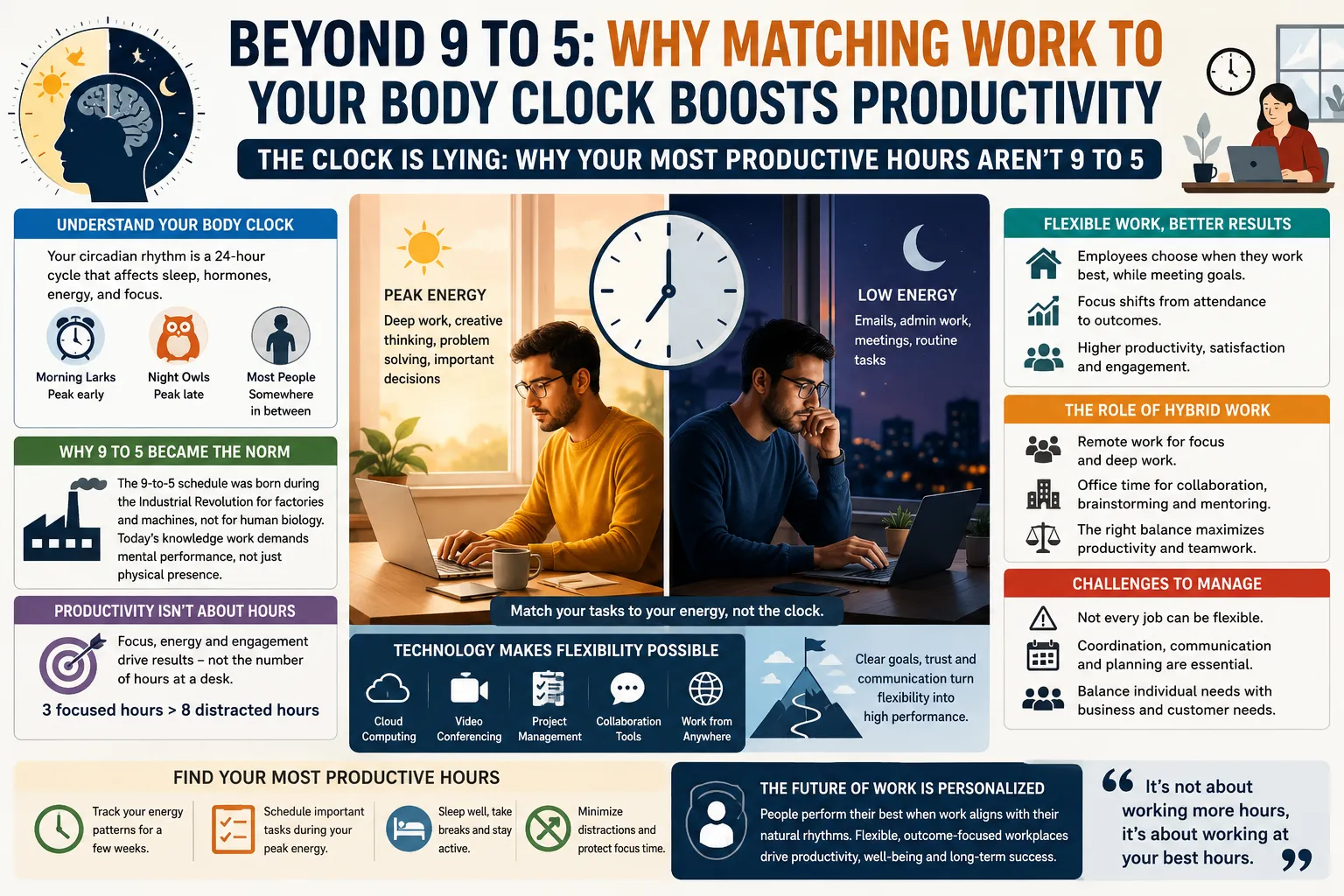
Every human body follows an internal 24-hour biological cycle known as the circadian rhythm. This natural clock regulates sleep, hormone production, body temperature, metabolism, and cognitive performance throughout the day.
Rather than functioning at a constant level of energy, people experience predictable peaks and dips in alertness. Some individuals wake up early feeling energized and perform their best during the morning hours. Others become increasingly productive later in the day or even during the evening.
Scientists commonly refer to these differences as chronotypes. While “morning larks” prefer early schedules, “night owls” often reach peak mental performance much later. Most people fall somewhere between these two extremes.
Recognizing these natural variations has important implications for modern workplaces, where rigid schedules may not always reflect employees’ optimal performance periods.
Why the Traditional 9-to-5 Model Developed
The standard workday was not originally designed around human biology.
Instead, the 9-to-5 schedule evolved during the Industrial Revolution when factories required workers to operate machinery simultaneously. Fixed shifts simplified production planning and allowed businesses to maintain consistent operations.
As economies transitioned from manufacturing to knowledge-based industries, the same work schedule remained largely unchanged despite dramatic shifts in the nature of work.
Today’s employees spend much of their day solving problems, creating ideas, collaborating digitally, and making complex decisions. These tasks rely more on mental performance than physical presence, making the timing of work increasingly important.
Productivity Is Not Measured by Hours Alone
One of the biggest misconceptions in the workplace is that spending more hours at a desk automatically leads to greater productivity.
Studies in organizational behavior consistently show that productivity depends more on focus, engagement, and energy than simply the amount of time spent working.
An employee who completes important tasks during three highly focused hours may achieve better results than someone working eight distracted hours.
This realization has encouraged many organizations to move toward performance-based evaluation rather than measuring success solely through attendance or logged working hours.
Flexible Work Is Changing Workplace Expectations
The widespread adoption of remote and hybrid work has accelerated discussions about flexible scheduling.
Many organizations discovered during recent years that employees remained productive even without following traditional office hours. Instead of monitoring when people logged in, managers increasingly evaluated completed projects, collaboration, and overall performance.
Flexible work allows employees greater control over when they perform demanding tasks, provided business objectives continue to be met.
This shift has encouraged organizations to rethink long-standing assumptions about productivity and workplace efficiency.
Matching Tasks to Energy Levels
Understanding personal energy patterns allows individuals to organize work more effectively.
Periods of peak alertness are generally best suited for activities requiring deep concentration, critical thinking, strategic planning, and complex decision-making.
During lower-energy periods, employees may find it more appropriate to schedule administrative work, routine emails, meetings, or repetitive tasks that demand less mental effort.
Rather than treating every hour equally, productivity experts encourage matching task difficulty with cognitive energy.
This approach can improve both work quality and efficiency.
Employee Well-Being and Performance Go Hand in Hand
Modern employers increasingly recognize that employee well-being directly influences business performance.
Sleep quality, stress management, physical health, and work-life balance all affect concentration, creativity, and decision-making.
Rigid schedules that conflict with an employee’s natural biological rhythm may contribute to fatigue, reduced engagement, and burnout over time.
Conversely, allowing greater flexibility where operationally feasible can improve job satisfaction, reduce stress, and enhance long-term productivity.
Organizations that prioritize employee well-being often experience stronger retention, lower absenteeism, and improved workplace morale.
The Role of Hybrid Work
Hybrid work has become one of the defining trends of the modern workplace.
By combining office attendance with remote work, hybrid models provide greater flexibility while maintaining opportunities for collaboration.
Many employees report that remote work enables them to complete focused tasks during their most productive hours without the distractions commonly associated with busy office environments.
Meanwhile, office days can be reserved for teamwork, brainstorming sessions, mentoring, and face-to-face communication.
This balance allows organizations to optimize both collaboration and individual productivity.
Technology Enables Greater Flexibility
Advances in digital technology have made flexible work arrangements increasingly practical.
Cloud computing, video conferencing, project management software, and collaborative platforms allow employees to communicate and complete work regardless of location or specific working hours.
Teams operating across different time zones have already demonstrated that productivity does not necessarily depend on everyone working simultaneously.
Instead, clear communication, shared goals, and effective coordination often matter more than synchronized schedules.
Technology has therefore become an important enabler of outcome-based work cultures.
Challenges of Flexible Scheduling
Although flexible work offers numerous advantages, it also presents challenges that organizations must carefully manage.
Not every industry can adopt fully flexible schedules. Healthcare, manufacturing, emergency services, transportation, retail, and customer support often require employees to be available during fixed operating hours.
Even within office environments, excessive flexibility without coordination may create communication delays or scheduling conflicts.
Successful flexible work policies therefore require thoughtful planning, clearly defined expectations, and effective leadership.
Organizations must balance individual preferences with operational requirements and customer needs.
Building a Results-Oriented Workplace
Many workplace experts argue that the future of work should emphasize results rather than physical presence.
This shift requires managers to define measurable objectives, communicate expectations clearly, and evaluate employees based on outcomes rather than visibility.
Trust becomes an essential component of this management style.
Employees who receive greater autonomy often demonstrate higher motivation and stronger ownership of their responsibilities.
At the same time, organizations benefit from improved efficiency, increased innovation, and stronger employee engagement.
Finding Your Most Productive Hours
Individuals can also take practical steps to identify their personal productivity patterns.
Observing daily energy levels over several weeks can reveal when concentration naturally peaks.
Some people perform best immediately after waking, while others reach maximum focus during late morning, afternoon, or evening.
Once these patterns become clear, important tasks can be scheduled during periods of highest mental performance whenever possible.
Simple habits such as maintaining consistent sleep schedules, taking regular breaks, staying physically active, and minimizing distractions further support sustained productivity.
The Future of Work Is Personalization
The modern workplace is increasingly moving away from one-size-fits-all approaches.
Instead of expecting every employee to perform at their best between 9 a.m. and 5 p.m., many organizations are exploring more personalized work arrangements that accommodate different working styles and biological rhythms.
Artificial intelligence, workforce analytics, and digital collaboration tools may further support individualized scheduling in the future.
As businesses continue adapting to changing employee expectations, flexibility is likely to become a competitive advantage in attracting and retaining skilled professionals.
Conclusion
The traditional 9-to-5 schedule has served organizations for generations, but changing workplace realities suggest that productivity cannot be defined by fixed office hours alone. Scientific understanding of circadian rhythms, combined with the rapid growth of hybrid and flexible work models, demonstrates that individuals perform differently depending on their natural biological clocks.
Rather than measuring success by attendance, leading organizations are increasingly focusing on outcomes, innovation, and employee well-being. By allowing greater flexibility where practical and encouraging employees to align demanding work with their peak energy periods, businesses can unlock higher productivity while supporting healthier and more engaged workforces.
Ultimately, the future of work is not about abandoning structure altogether—it is about recognizing that the best work often happens when people are given the opportunity to perform at the times when they are naturally at their best.
roystonhotel roystonhotel roystonhotel roystonhotel roystonhotel roystonhotel roystonhotel roystonhotel roystonhotel roystonhotel roystonhotel roystonhotel roystonhotel roystonhotel roystonhotel roystonhotel roystonhotel roystonhotel roystonhotel roystonhotel roystonhotel roystonhotel roystonhotel roystonhotel roystonhotel roystonhotel roystonhotel roystonhotel roystonhotel roystonhotel roystonhotel roystonhotel roystonhotel roystonhotel roystonhotel roystonhotel roystonhotel roystonhotel roystonhotel roystonhotel roystonhotel roystonhotel roystonhotel roystonhotel roystonhotel roystonhotel roystonhotel roystonhotel roystonhotel roystonhotel roystonhotel roystonhotel roystonhotel roystonhotel roystonhotel roystonhotel roystonhotel roystonhotel roystonhotel roystonhotel roystonhotel roystonhotel roystonhotel roystonhotel roystonhotel roystonhotel roystonhotel roystonhotel roystonhotel roystonhotel roystonhotel roystonhotel roystonhotel roystonhotel roystonhotel roystonhotel roystonhotel roystonhotel roystonhotel roystonhotel roystonhotel roystonhotel roystonhotel roystonhotel roystonhotel roystonhotel roystonhotel roystonhotel roystonhotel roystonhotel roystonhotel roystonhotel roystonhotel roystonhotel roystonhotel roystonhotel roystonhotel roystonhotel roystonhotel roystonhotel roystonhotel roystonhotel roystonhotel roystonhotel roystonhotel roystonhotel roystonhotel roystonhotel roystonhotel roystonhotel roystonhotel roystonhotel roystonhotel roystonhotel roystonhotel roystonhotel roystonhotel roystonhotel roystonhotel roystonhotel roystonhotel roystonhotel roystonhotel roystonhotel roystonhotel roystonhotel roystonhotel roystonhotel roystonhotel roystonhotel roystonhotel roystonhotel roystonhotel roystonhotel roystonhotel roystonhotel roystonhotel roystonhotel roystonhotel roystonhotel roystonhotel roystonhotel roystonhotel roystonhotel roystonhotel roystonhotel roystonhotel roystonhotel roystonhotel roystonhotel roystonhotel roystonhotel roystonhotel roystonhotel roystonhotel roystonhotel roystonhotel roystonhotel roystonhotel roystonhotel roystonhotel roystonhotel roystonhotel roystonhotel roystonhotel roystonhotel roystonhotel